How to Make
Homemade Pasta
from Scratch
Make flour and eggs into tagliatelle—or durum semolina and water into southern shapes—with hand and machine methods, precise visual cues and no assumption that all Italian pasta begins with the same dough.

Fresh pasta is not one formula.
Emilian egg sfoglia combines soft-wheat flour and eggs. It rolls into supple sheets for tagliatelle, lasagne, ravioli and tortellini.
Southern semolina pasta combines remilled durum semolina and water. Its firm, eggless dough is dragged, rolled or pressed into shapes such as orecchiette, cavatelli and strascinati.
What do you want to make?
| If you want to make | Start with | Why |
|---|---|---|
| Tagliatelle | Egg sfoglia | Supple sheet cuts into porous ribbons |
| Lasagne sheets | Egg sfoglia | Rolls evenly for thin layers |
| Ravioli | Egg sfoglia | Seals around a filling without cracking |
| Tortellini | Egg sfoglia | Can be rolled very thin and folded |
| Orecchiette | Semolina + water | Firm dough drags into rough cups |
| Cavatelli | Semolina + water | Small pieces hold a rolled hollow |
| Strascinati | Semolina + water | Dragged shape needs durum firmness |
These are useful starting traditions, not borders policed by a single national recipe. Local and household formulas vary.
Household craft, regional grain and skilled hands.
Homemade pasta was not invented at one documented moment. Italian households developed many doughs around available grain, climate, labour and local dishes. Southern durum wheat supports firm water doughs and dried pasta; along the Via Emilia, soft-wheat flour and eggs became central to the domestic art of sfoglia.
The sfoglina is the skilled maker who kneads, turns and thins egg dough on a wooden spianatoia with a long mattarello. The craft moved from unpaid household work into classes, pasta shops and professional production, while institutions such as Casa Artusi and Bologna Welcome continue to document hand technique.
Pellegrino Artusi did not invent fresh pasta. His Science in the Kitchen and the Art of Eating Well, first published in 1891 and expanded through 1911, matters because it recorded and circulated domestic Italian cooking during national consolidation. Fresh and dried pasta continued side by side rather than forming a simple old-versus-new sequence.
Migration carried regional habits into new kitchens, including South Africa. That does not make every dish interchangeable: a handmade ribbon can be right for ragù while dried spaghetti or rigatoni remains the more traditional choice for many Roman and southern preparations. For the wider evidence and the Marco Polo myth, use the History of Pasta research hub.
Emilian-style egg sfoglia
- Flour
- 400 g type 0 soft-wheat flour, or suitable plain flour
- Eggs
- 4 medium eggs, about 50 g each without shell
- Yield
- About 600 g dough; 4 mains or 6 starters
- Timing
- 35 minutes active + about 30 minutes covered rest
Casa Artusi teaches 400 g type 0 flour with four medium 50 g eggs. Bologna Welcome describes one egg per 100 g flour as an average dependent on egg and flour moisture. Keep some flour aside and let the dough decide.
Semolina and water dough
- Semola
- 300 g fine semola rimacinata
- Water
- 150 g warm water; hold back 10 g and adjust
- Yield
- About 450 g dough; 4 servings
- Timing
- 30 minutes active + about 30 minutes covered rest
Italia.it documents Puglian fresh pasta made from durum-wheat flour and water. A 50% starting hydration is practical, but fine milling, brand and weather change absorption.
“00” is a grade—not a guarantee.
| Flour | Best use here | Texture | What to know in South Africa |
|---|---|---|---|
| Italian type 0 | Egg sfoglia | Balanced tenderness and strength | The Casa Artusi reference; a moderate-protein plain flour is the practical local analogue. |
| Italian type 00 | Egg sheets when the specific flour suits pasta | Fine, smooth dough | 00 describes Italian ash/refinement limits, not one protein strength. Read the intended use. |
| Plain or cake flour | Accessible egg pasta | Tender and extensible | South African naming differs by mill. Choose unbleached flour with useful structure, then adjust by feel. |
| Bread flour | Blend only when local plain flour is exceptionally weak | Stronger, springier chew | It can fight the rolling pin; it is not automatically a better pasta flour. |
| Semola rimacinata | Orecchiette, cavatelli, strascinati | Firm, warm-yellow, slightly rough | Look for fine remilled durum semolina. Coarse semolina hydrates differently and feels gritty. |
Protein helps describe potential structure, but it does not alone predict extensibility or gluten quality. Italian 0/00 categories primarily concern milling/refinement; “00 is always best” is not useful advice.
Eggs bring water, fat and protein. Whites contribute much of the water and strengthening protein; yolks bring fat, colour and tenderness. Weighing shelled egg is more reproducible than trusting a size word.
A machine is optional.
The essentials are a scale, roomy board, scraper, fork, covering bowl or wrap, a long rolling pin and a sharp knife. A wooden board offers a little friction; a stone counter works but can feel cooler and slicker.
Traditional core
- Wooden spianatoia or large board
- Long straight mattarello
- Raschia or bench scraper
- Sharp coltella or chef's knife
- Pastry wheel for filled pasta
Modern helpers
- Digital scale
- Securely clamped pasta machine
- Ravioli cutter or stamp
- Drying rack for brief holding
- Freezer trays and sealed containers
Egg pasta, from flour to sauce.
Read the dough at every stage. The photographs support the instructions; no critical action exists only in an image.
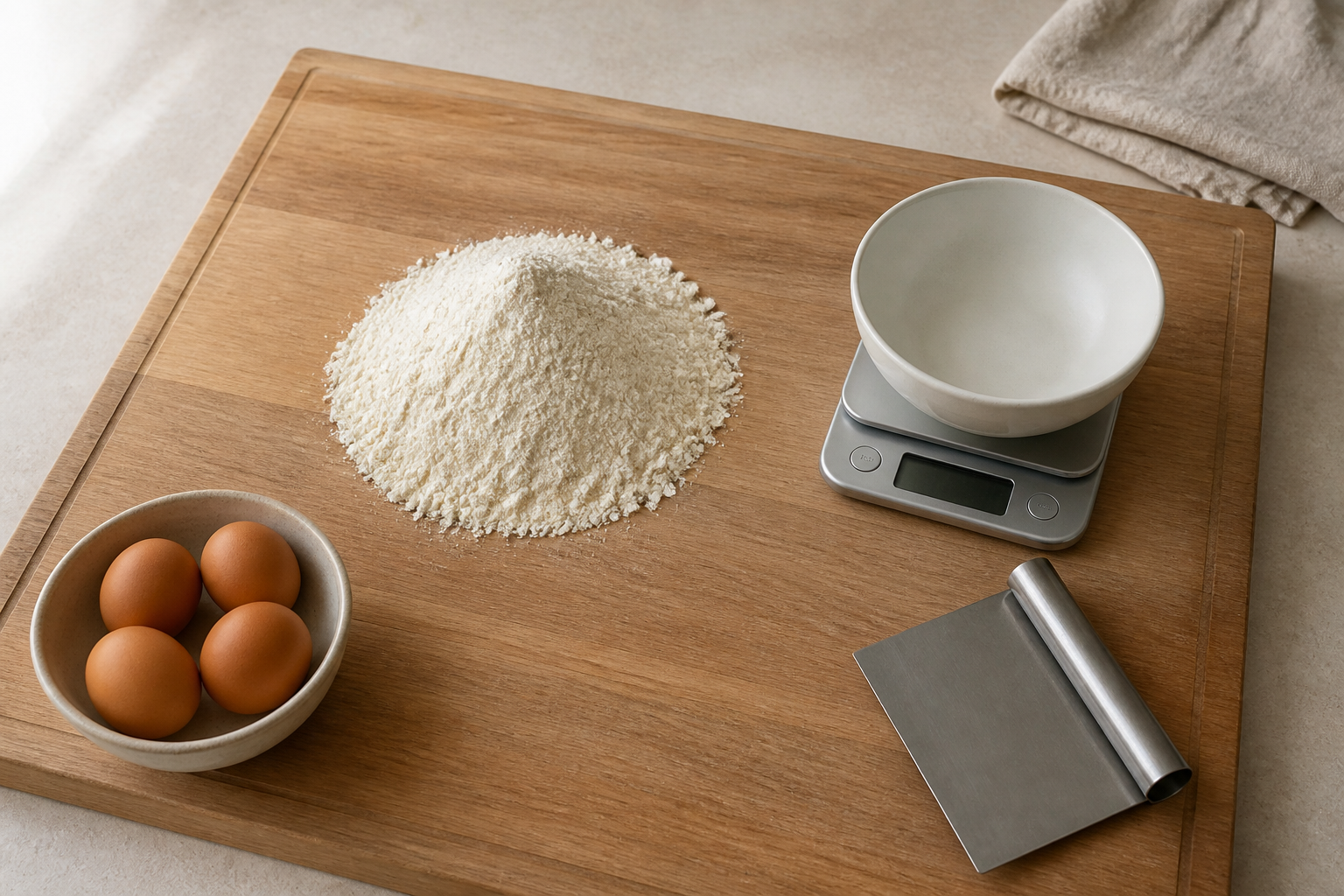 Step 01
Weigh the flour
Weigh 400 g flour. Volume measures compact unpredictably; a scale gives you a repeatable starting point and makes later adjustments small.
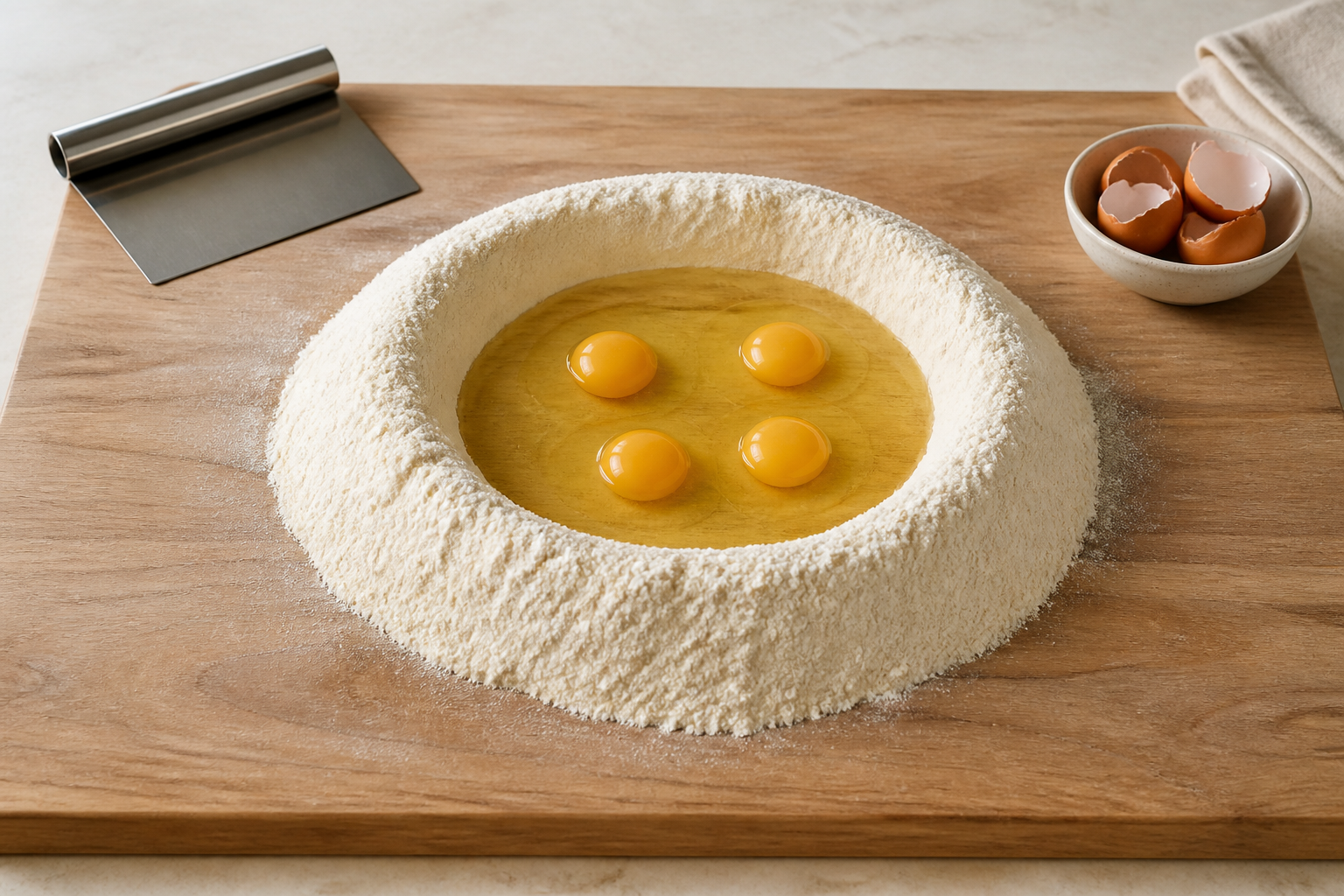 Step 02
Build a broad flour well
Make a wide crater with a clean wooden centre and walls high enough to contain four eggs. Crack each egg into a bowl first if you want an easy shell check.
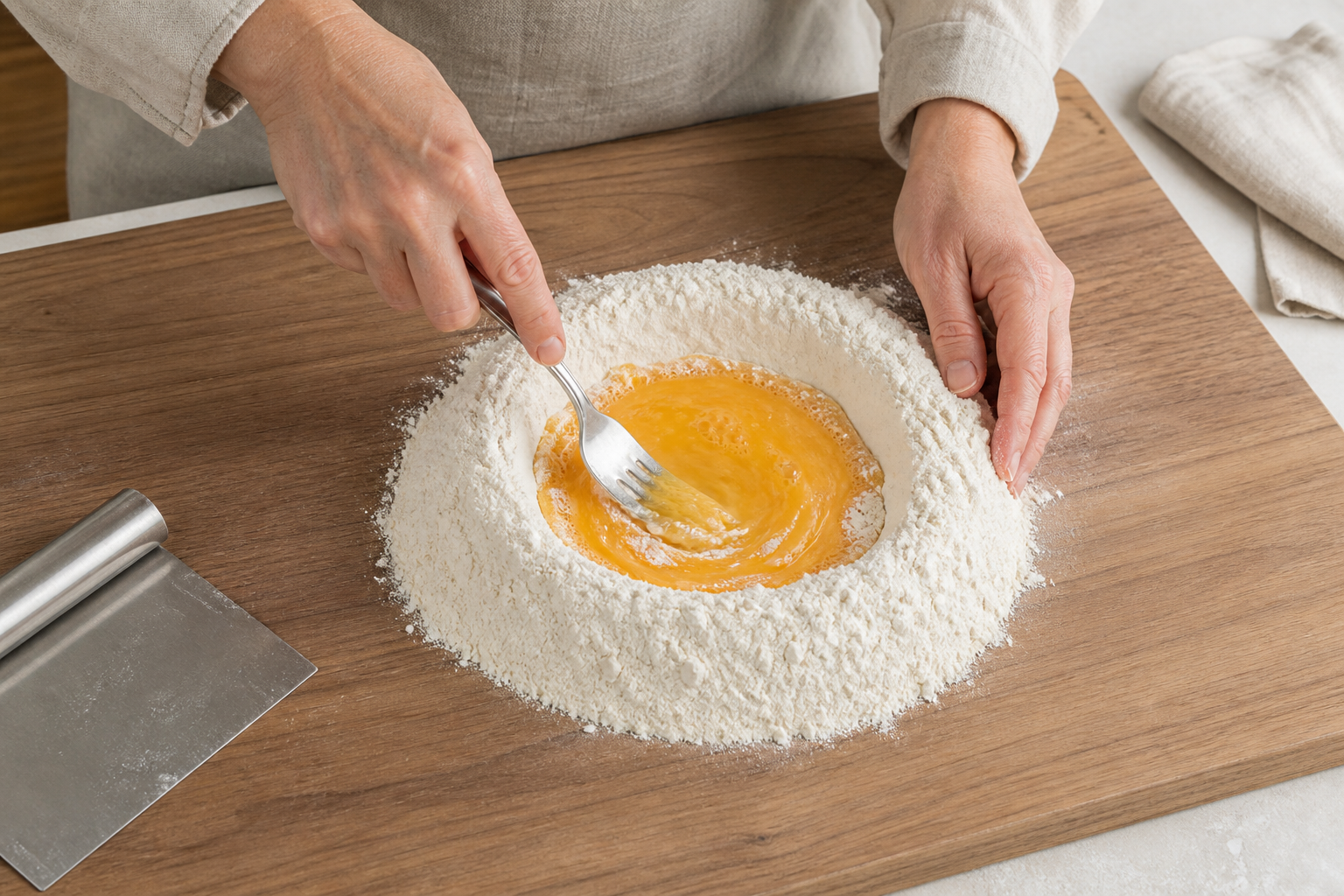 Step 03
Beat the eggs gradually
Break the yolks with a fork and beat within the centre. Keep the tines low so you do not puncture the flour wall.
- Step 04
Draw in the inner flour
Scrape only the inside face of the well into the eggs. Continue until the centre becomes a thick batter, then use the scraper to gather the outer flour.
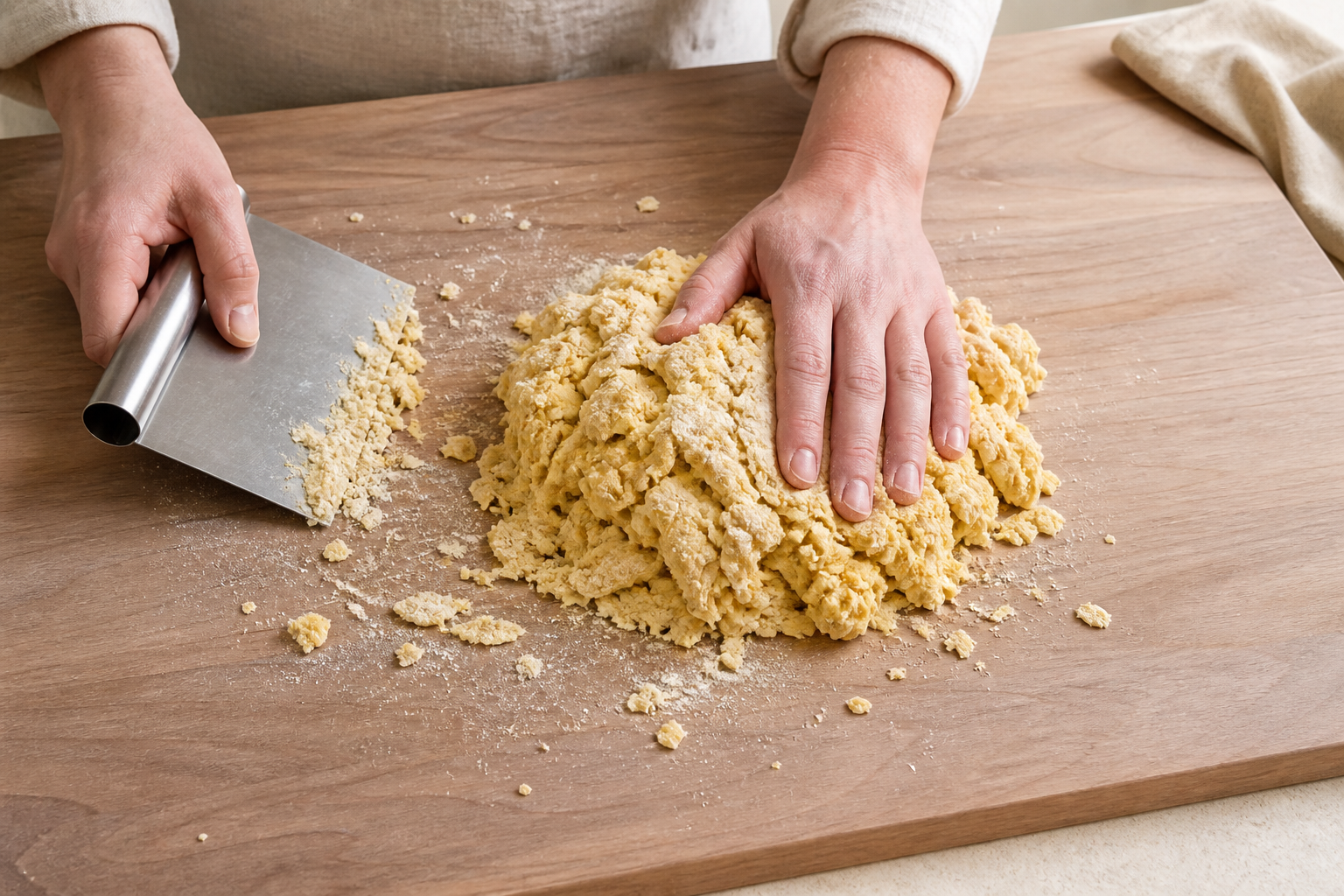 Step 05
Form the shaggy dough
Press the damp pieces and crumbs together. This rough, torn-looking stage is normal; loose liquid egg should be gone, but the dough does not need to look smooth.
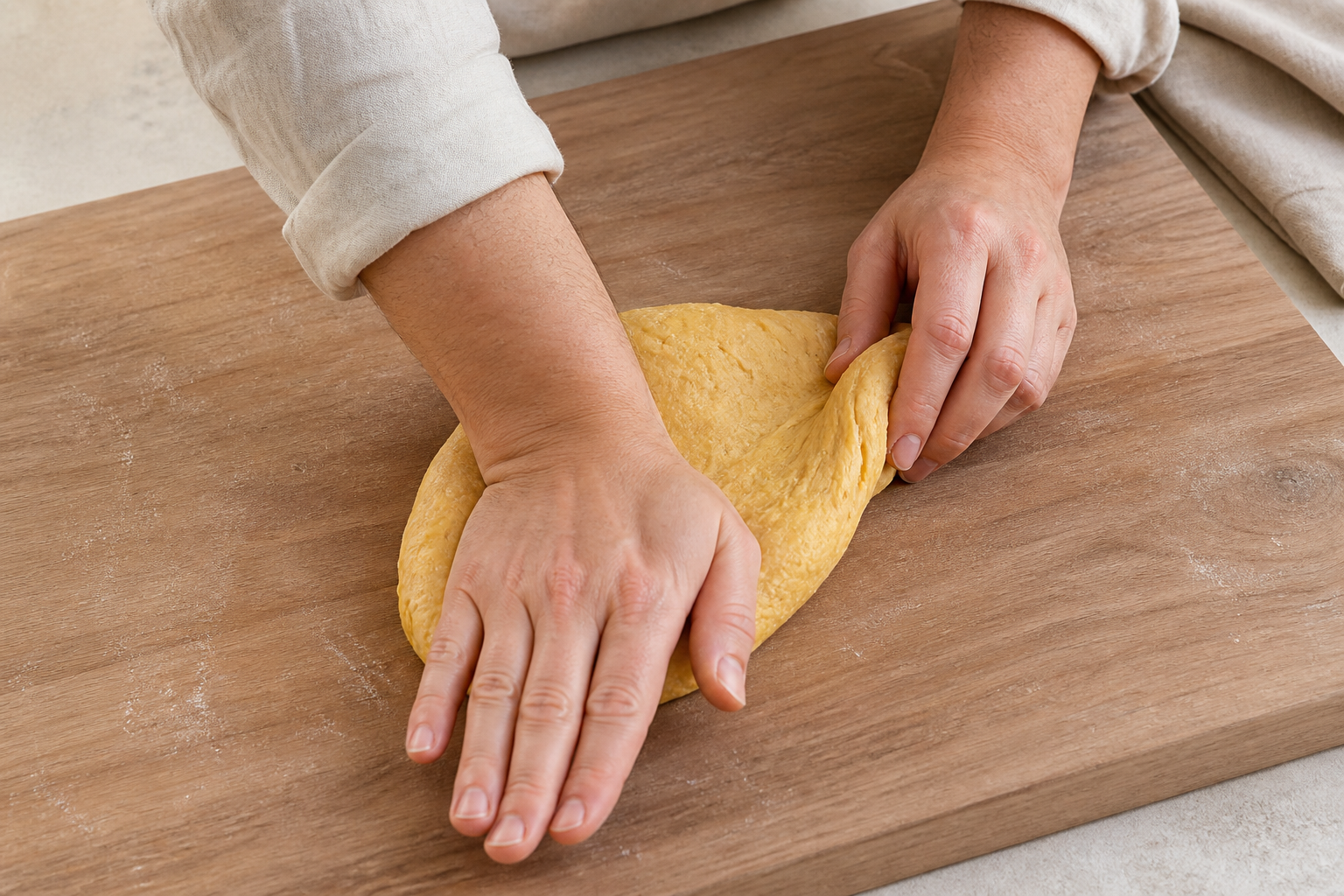 Step 06
Knead with push, fold and turn
Push the dough away with the heel of your hand, fold it back, turn it and repeat for roughly 8–12 minutes. Scrape the board clean rather than burying sticky smears in extra flour.
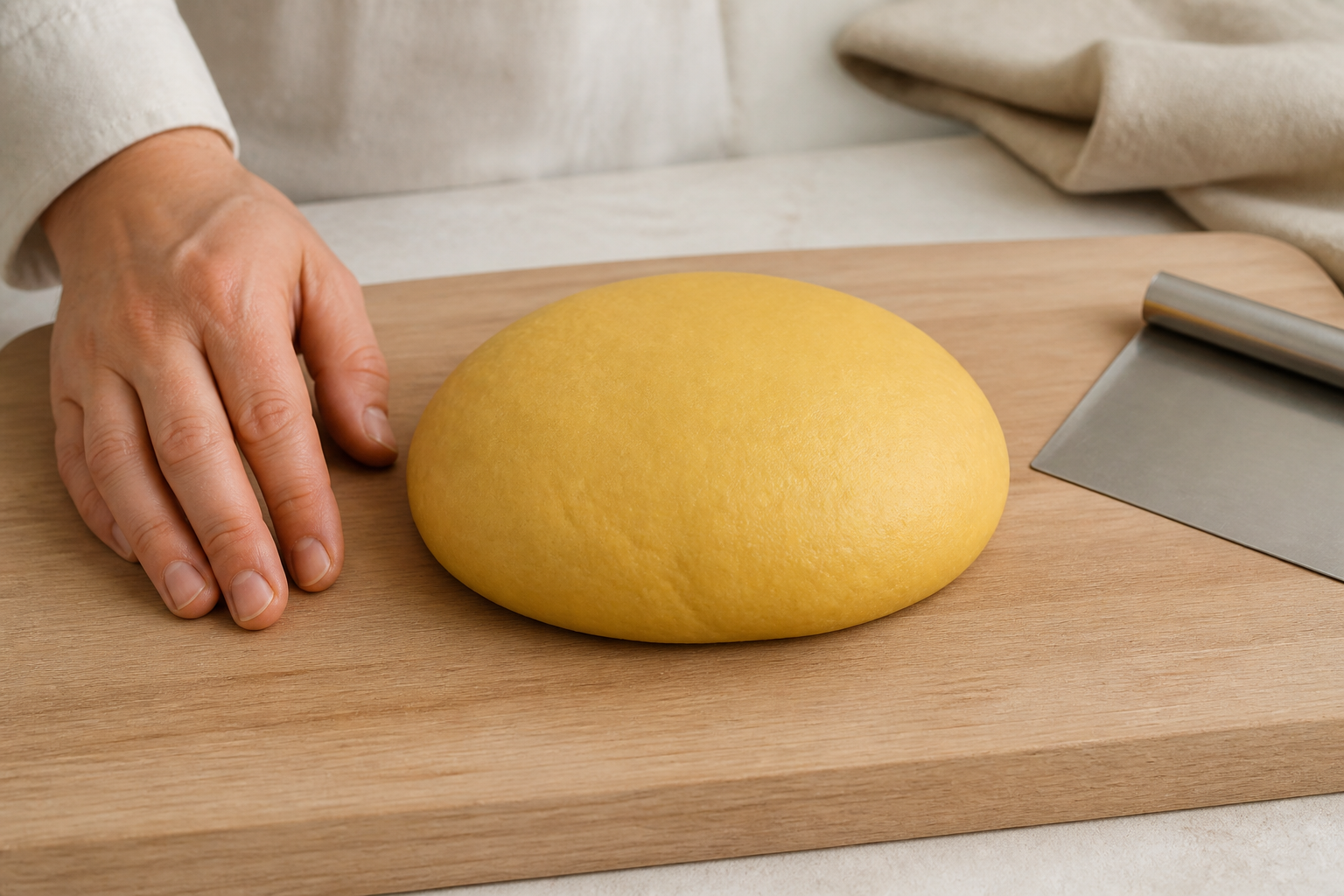 Step 07
Judge the hydration
Correct dough is firm, cohesive and only faintly tacky. It should yield under a thumb without smearing. A few surface dimples are more honest than a perfectly polished ball.
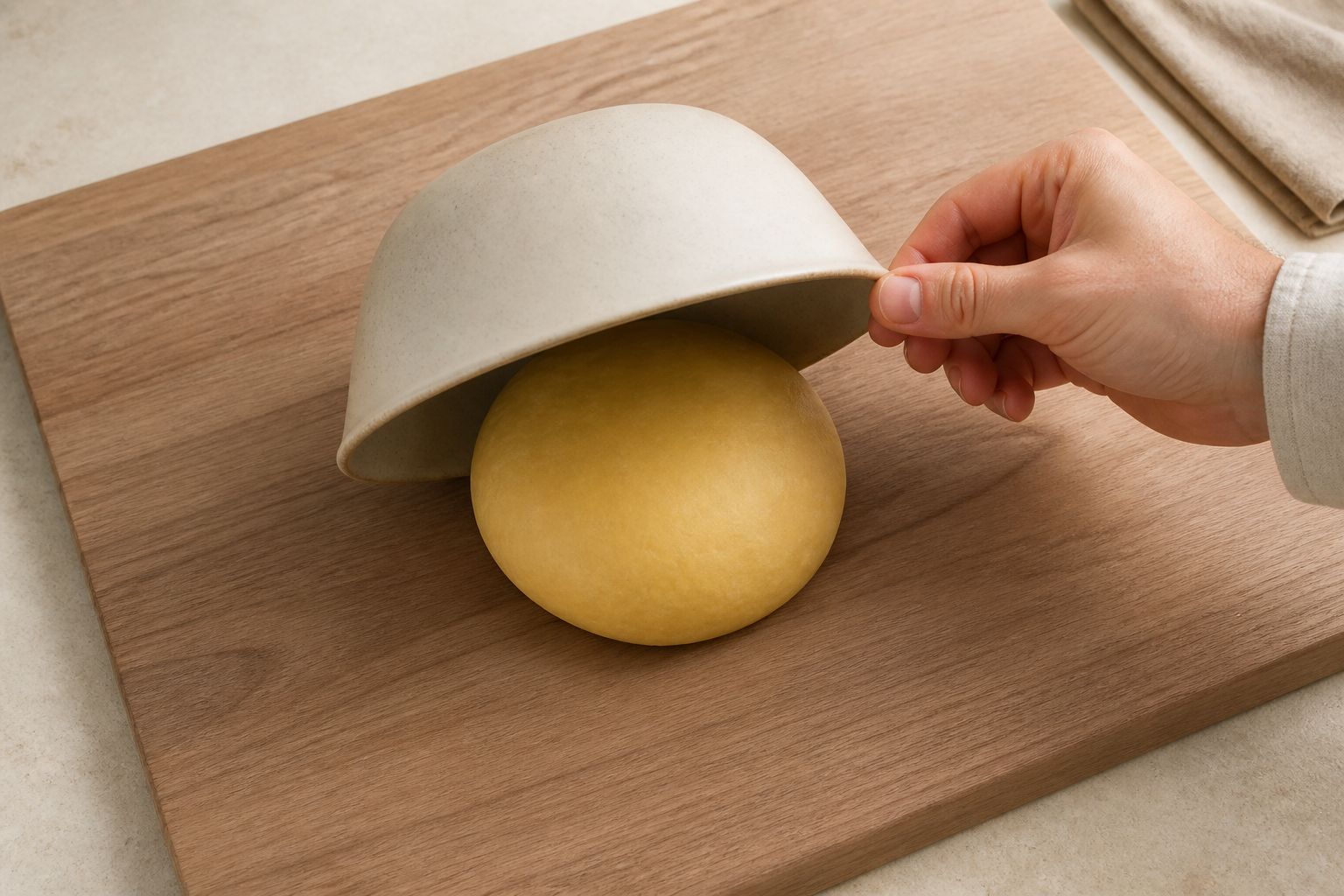 Step 08
Rest it covered
Cover so no skin can form and rest at room temperature for about 30 minutes. Recipes vary because flour, hydration, kneading and the final shape vary.
- Step 09
Divide and protect
Cut the batch into four pieces. Work with one and keep the other three covered. Smaller portions roll more evenly and spend less time exposed to air.
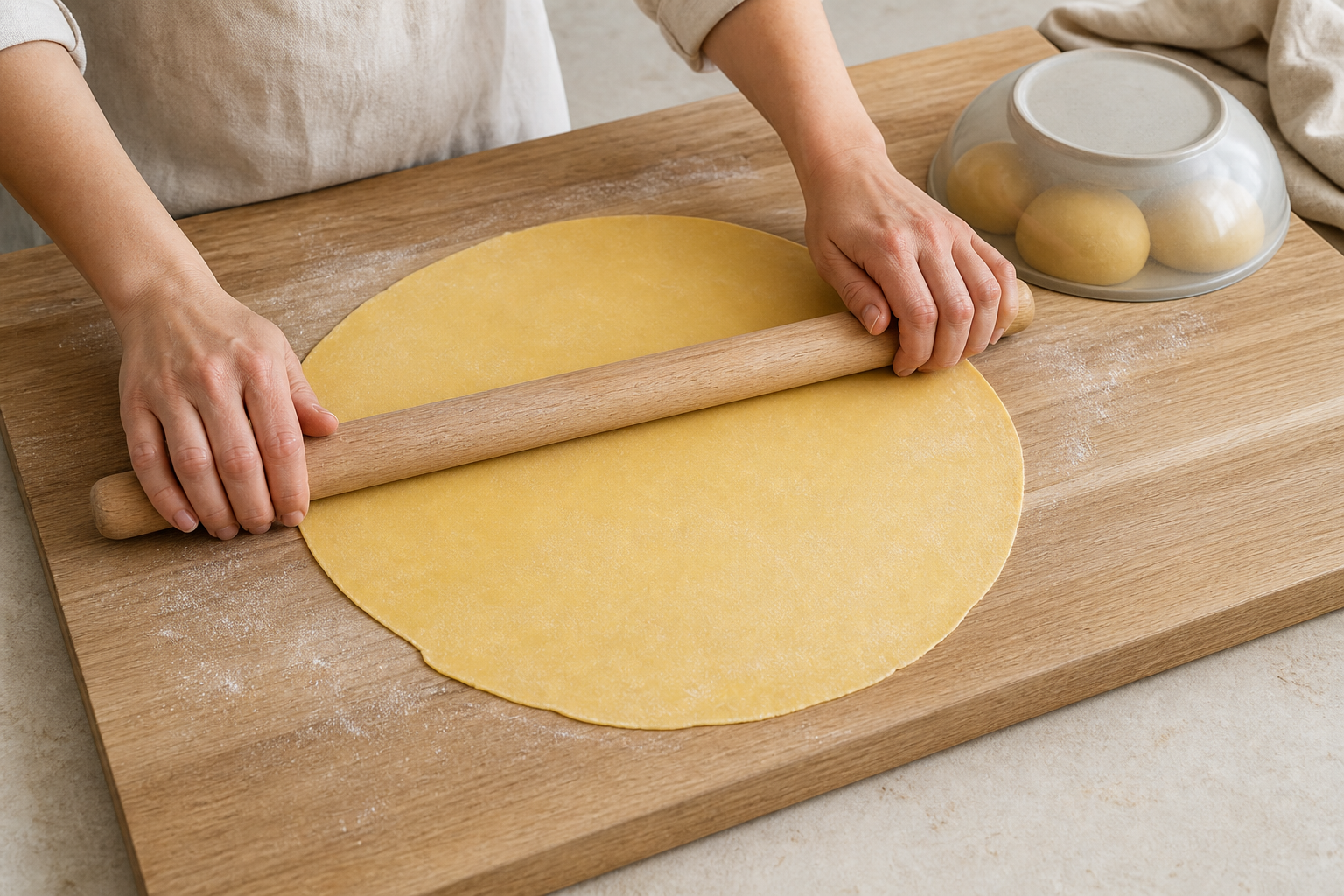 Step 10
Flatten the first piece
Press the portion into a squat disc and begin from the centre. Turn it often so thickness and shape remain even before serious thinning begins.
- Step 11
Roll with a mattarello
Use a long straight pin, even pressure and frequent quarter turns. Roll away from the centre, rotate, and use only enough flour to prevent sticking.
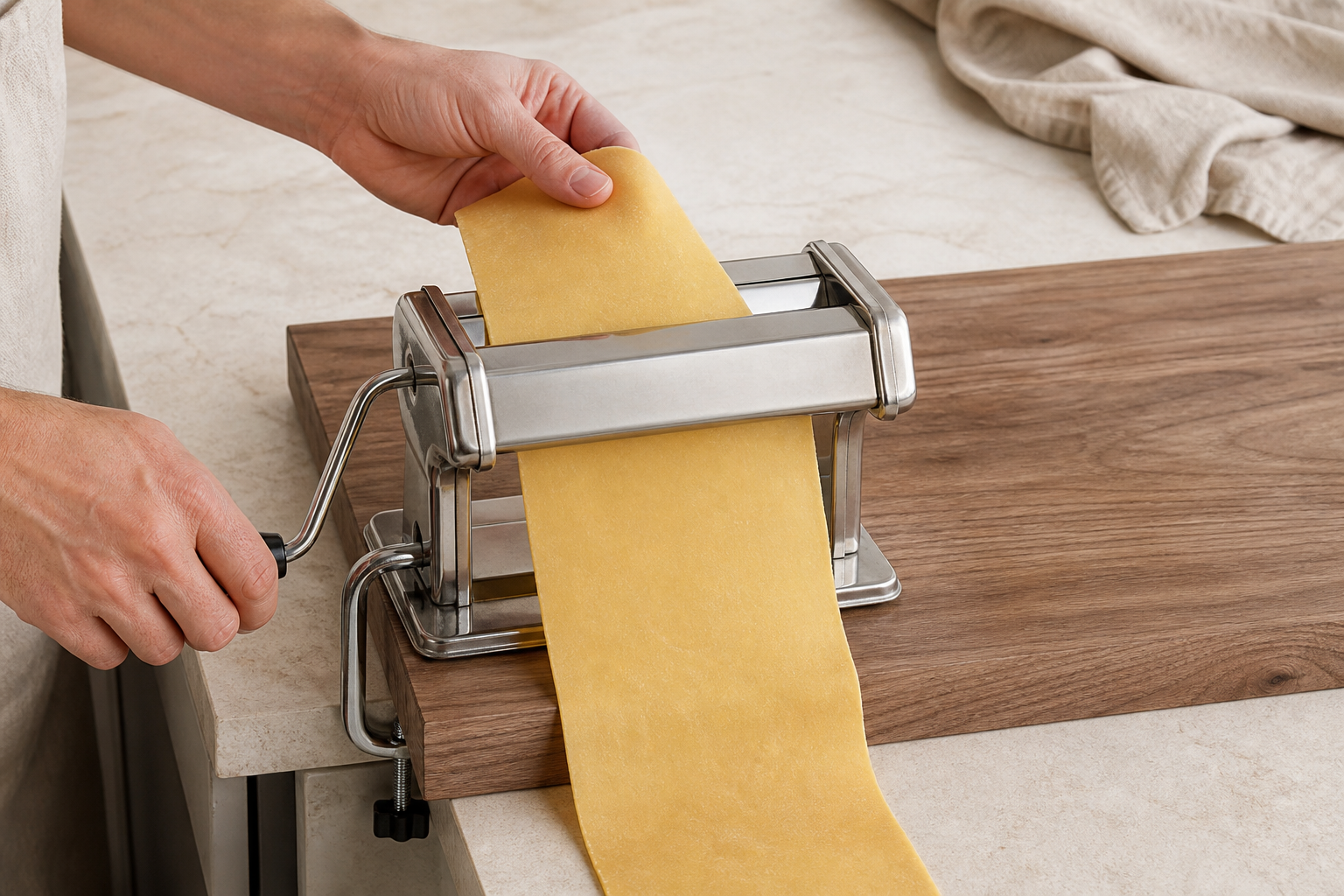 Step 12
Or roll with a machine
Clamp the machine securely. Start at its widest setting, pass the flattened dough through, and reduce one setting at a time. Fold early passes only when the sheet needs squaring or strengthening.
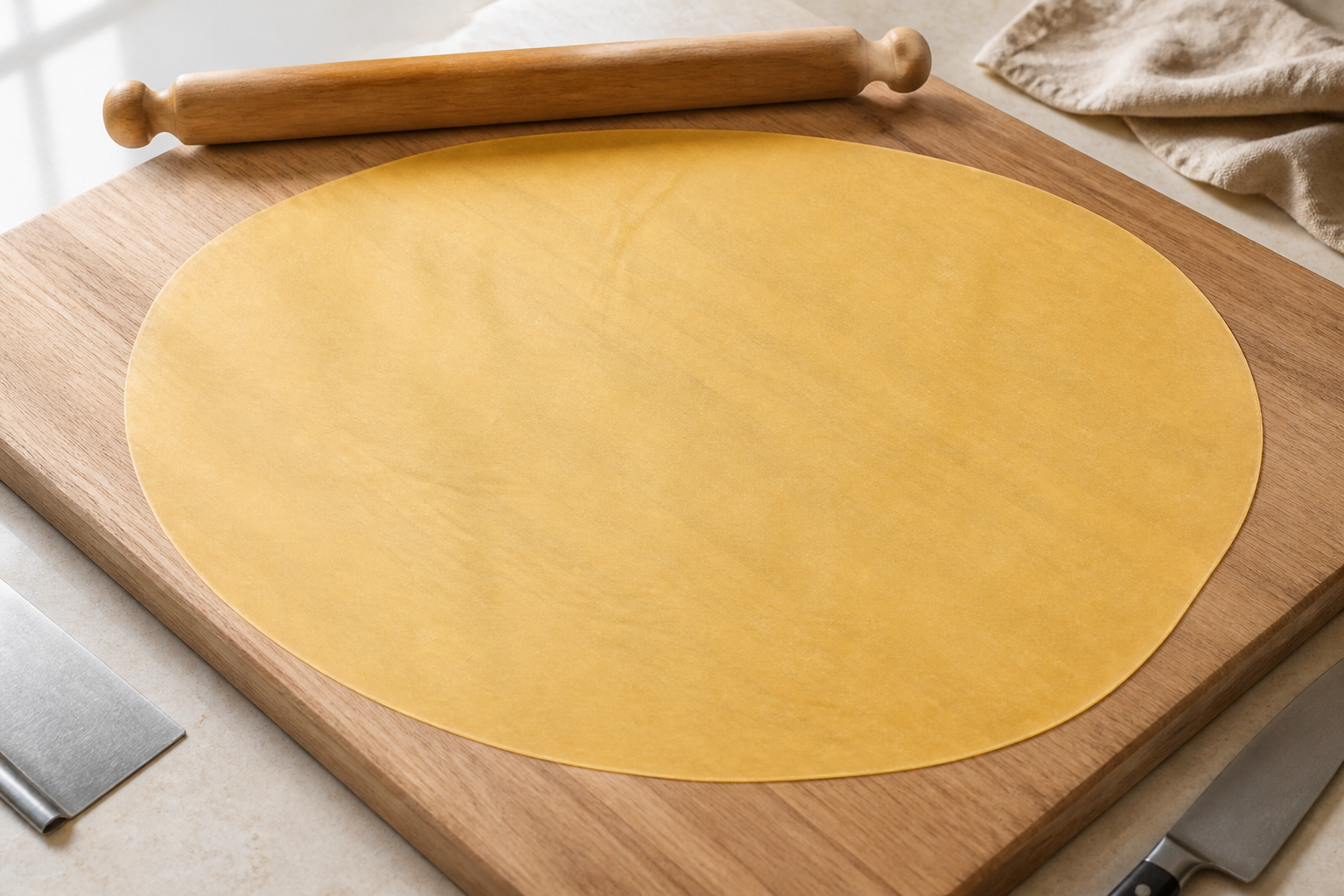 Step 13
Read the finished sfoglia
The sheet should be even, supple and thin enough for diffuse light or faint board grain to show through. That is a practical cue, not an exact scientific test or a demand for transparency.
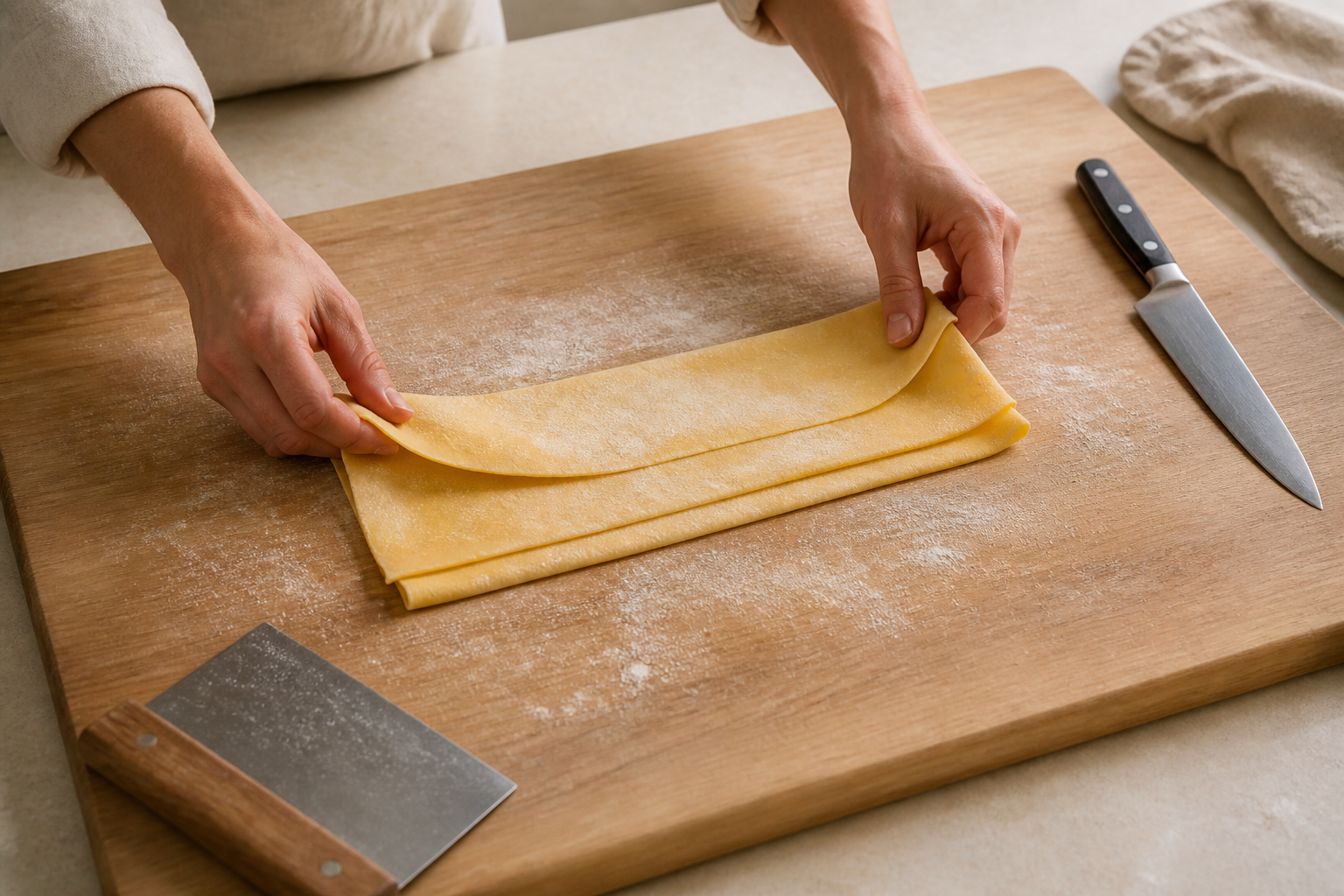 Step 14
Let the surface lose tack
Leave the sheet briefly until its surface feels dry but the edges still bend without cracking. Dust lightly, then fold loosely from both sides.
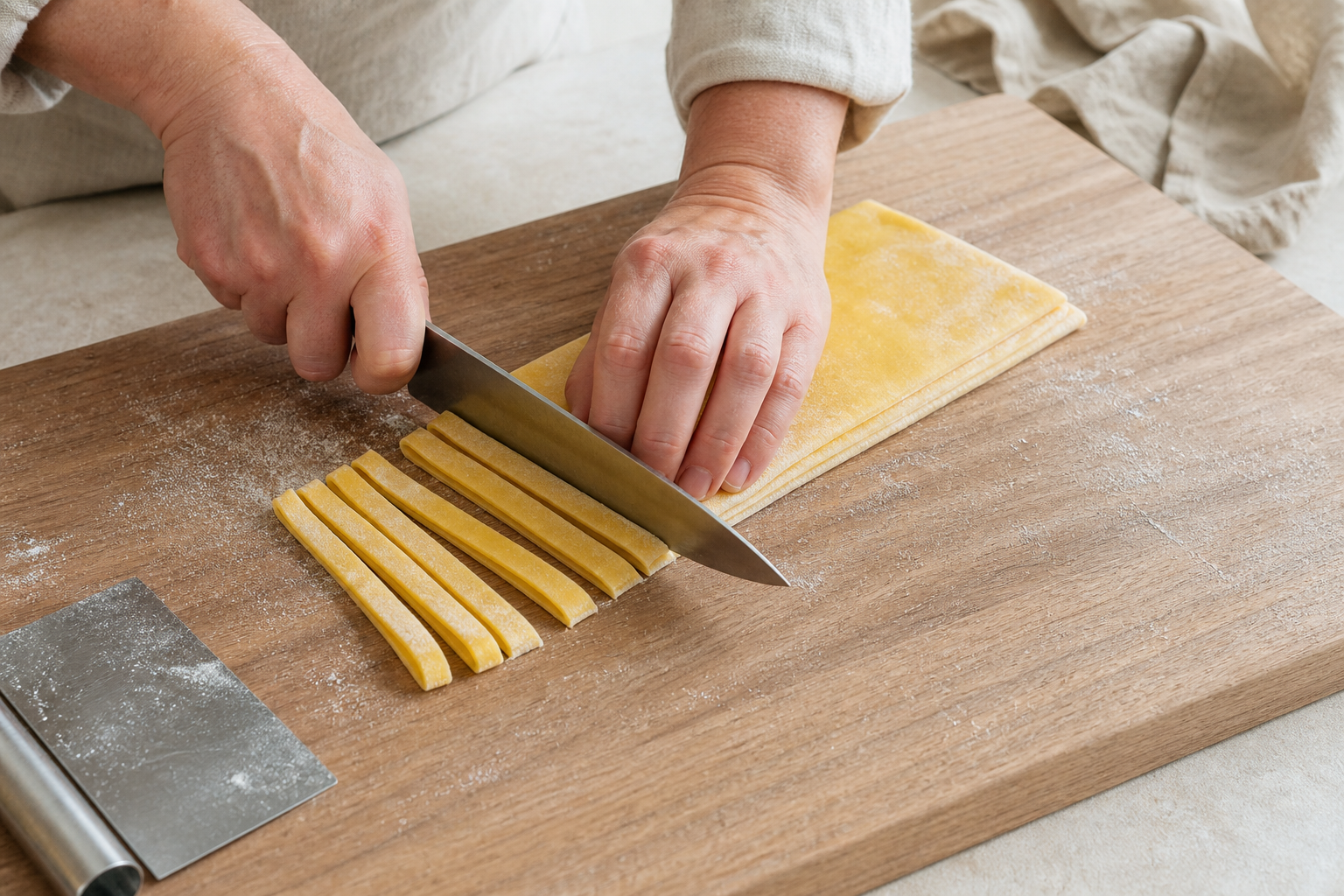 Step 15
Cut tagliatelle safely
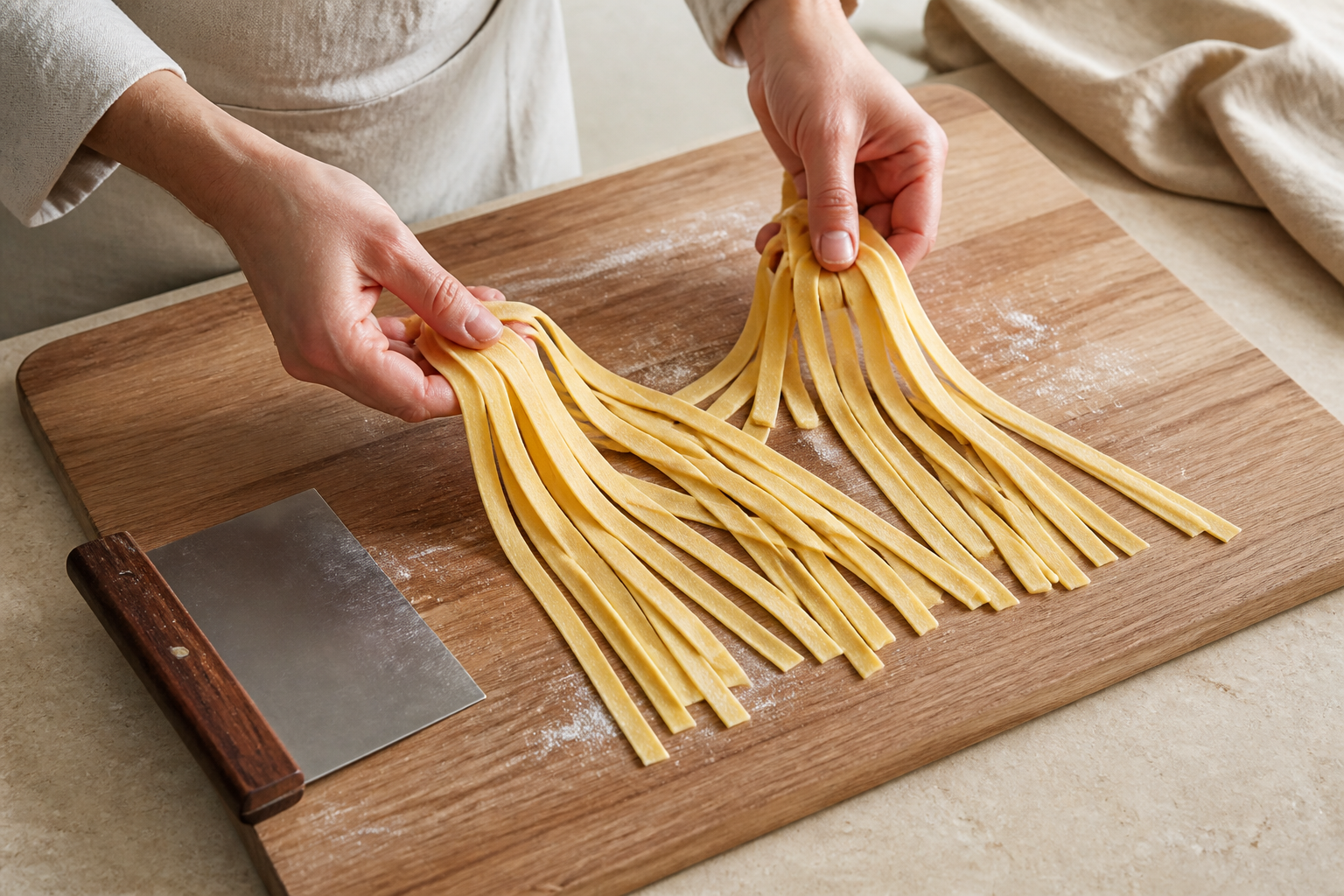
With fingertips curled safely back, cut across the loose stack into ribbons about 7 mm wide. Lift the knife rather than sawing or crushing the folds.
 Step 16
Separate the ribbons
Unfurl immediately and toss gently with a whisper of flour or fine semolina. Separate strands with your fingers before arranging portions.
 Step 17
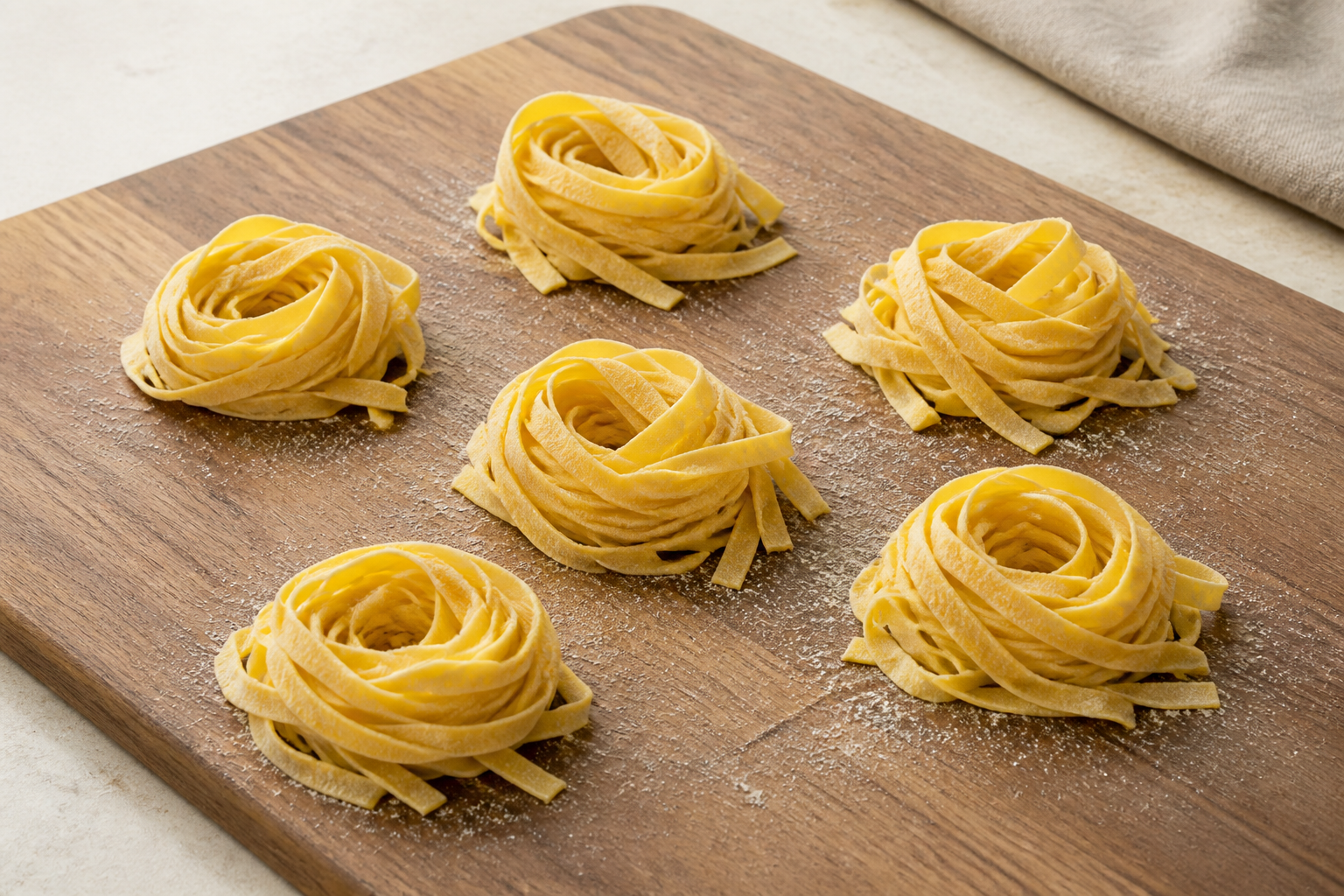
Make loose nests
Gather serving-size bundles into loose, airy nests and keep them apart. Have the sauce ready before the pot: fresh pasta will not wait politely in a colander.
 Step 18
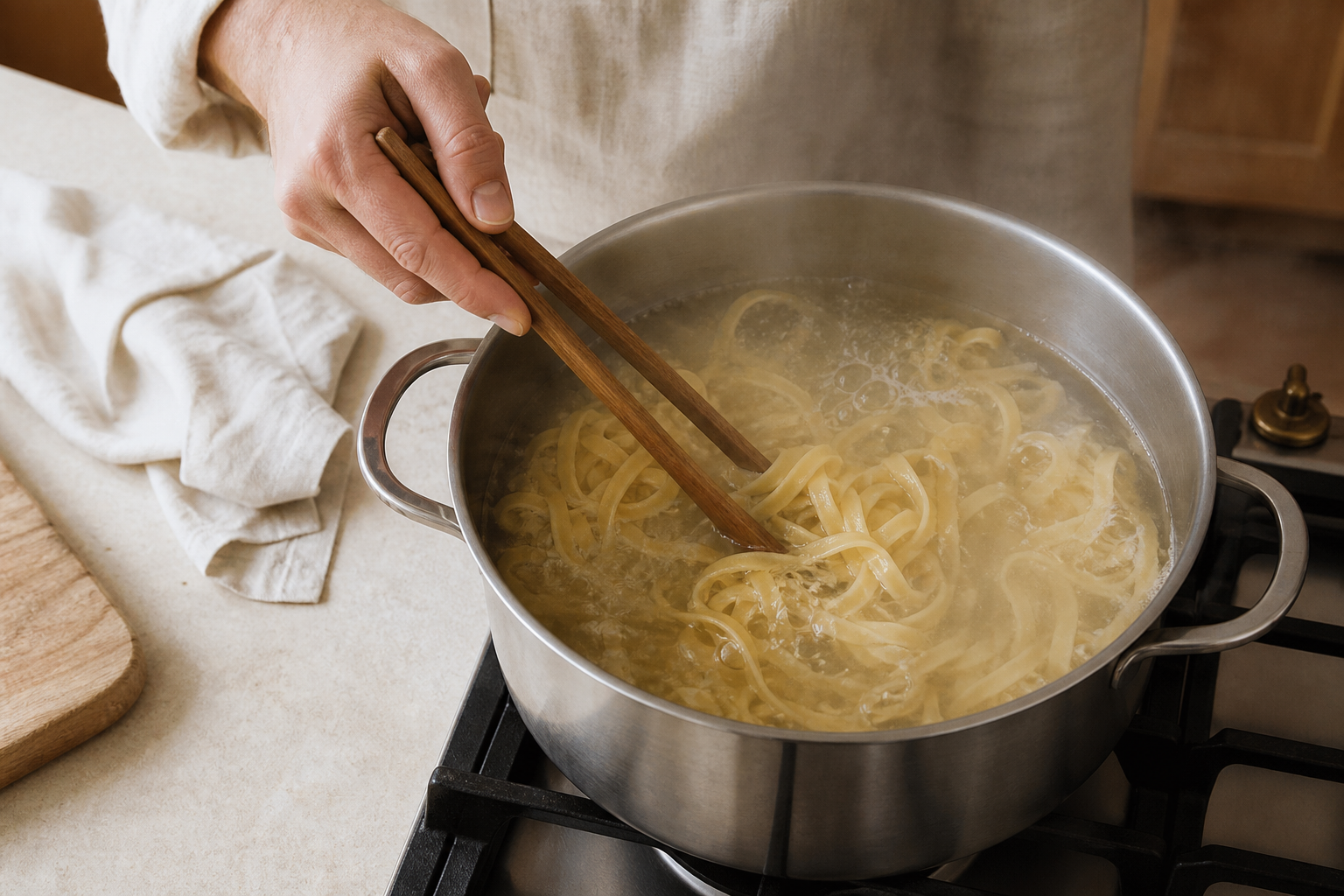
Cook, taste and finish
Lower the pasta into well-salted boiling water, stir gently and begin tasting early. Depending on shape and thickness, it may need only 1–4 minutes. Move it directly into ready sauce and toss briefly.


Semolina and water, step by step.
This is not egg sfoglia with the eggs removed. Durum dough is firmer, less rich and well suited to dragged or hand-rolled shapes.


- Mix: pour about 140 g warm water into 300 g semola; gather and add the reserved water only as needed.
- Knead: work 8–10 minutes until firm, smooth and cohesive. Expect more resistance than egg dough.
- Rest: cover for about 30 minutes so moisture equalises and the dough becomes easier to shape.
- Roll: cut a portion and roll it into a rope roughly 1 cm thick; keep the remaining dough covered.
- Cut and drag: cut 1 cm pieces. Drag each with the blunt side of a smooth knife, then turn it over your thumb.
- Cook: taste the thicker rim. Fresh orecchiette often needs longer than thin egg ribbons.
Continue with the visual Orecchiette guide and Orecchiette alle Cime di Rapa.
Plan a practical batch.
This scales Casa Artusi's practical one-egg-per-100-g model. Egg and flour absorption still vary, so judge the dough rather than forcing every last gram into it.
Dough not behaving?
Too dry or crumbly
Likely cause: The flour has not absorbed enough liquid, or loose flour was forced in too early.
What to do: Keep kneading for 2 minutes first. If it still will not hold when squeezed, wet your hands and knead again. Add moisture drop by drop—not a splash.
Use the sheet, not a universal machine number.
| Shape | Useful thickness cue | Cut or next action |
|---|---|---|
| Lasagne | Supple and thin, but strong enough to lift as a full sheet | Cut to fit the dish; blanch only if the recipe or sheet requires it |
| Tagliatelle | Diffuse light is visible; sheet bends without tearing | About 6–8 mm ribbons |
| Pappardelle | Slightly more body for rich sauce | About 20–30 mm ribbons |
| Ravioli | Thin enough to avoid a doughy double border | Fill sparingly, expel air, seal clean edges |
| Tortellini | Very thin, moist enough to fold without cracking | Small squares; fill and fold promptly |
Machine setting numbers differ by manufacturer and model. Start wide, move one step at a time and record the setting that produces the visible result you need.
Homemade is not a synonym for more authentic.
Choose fresh egg pasta
Use its tender, porous sheet for tagliatelle with ragù, filled pasta, delicate butter dressings and layered dishes where supple dough belongs to the regional method.
Choose water-and-semolina pasta
Use its firm chew for handmade southern shapes such as orecchiette and cavatelli, especially with greens, legumes and crumbled ingredients.
Choose dried pasta
Carbonara, amatriciana, puttanesca and many seafood or oil-based dishes are not improved simply by replacing the expected dried durum shape with fresh egg ribbons.
Have the sauce ready first.
Allow roughly 100–125 g fresh unfilled pasta per adult main course or 70–90 g for a starter; filled pasta depends strongly on filling and richness. Use the portion calculator for planning.
Use ample salted water and a controlled boil. Begin tasting thin ribbons after one minute. Transfer directly to sauce, reserving water, and finish briefly using the method in When to Finish Pasta in Sauce.
Do not confuse brief drying with preservation.
A short uncovered period reduces surface tack; it does not make moist egg pasta shelf-stable. Cook it the same day where possible. Refrigerate covered dough or shaped pasta promptly at 4°C or colder and use within 24 hours as a conservative home-kitchen rule.
For longer keeping, tray-freeze separated ribbons, nests or filled pieces until firm, then seal, date and return to the freezer. Cook from frozen. Filled pasta containing meat or cheese deserves especially careful cold handling.
Egg pasta is perishable food.
Start with clean hands and surfaces, keep eggs refrigerated, avoid tasting raw dough and prevent contact with raw meat fillings. South Africa's Department of Health advises prompt cooling/storage and thorough cooking; USDA guidance keeps eggs at 4°C/40°F or colder.
Discard dough left warm for extended periods, or anything with an uncertain storage history, off odour or visible mould. Vulnerable diners need particular caution with raw or undercooked egg products.
Homemade pasta troubleshooting.
Correct the process that produced the symptom; adding flour or water blindly can exchange one problem for another.
Dough is crumbly
It may simply be early in hydration. Knead first; if it still will not bind, wet your hands and continue. A teaspoon poured in at once can overshoot.
Dough is too sticky
Large eggs, humid weather or incomplete kneading can be responsible. Clean the board, knead, then use only a light dusting of flour.
Dough springs back
Gluten is tense. Cover it and rest 10–20 minutes before continuing; forcing it only makes rolling harder.
Dough tears when rolling
It may be dry, under-kneaded or stretched through machine settings too quickly. Return to a thicker setting and progress gradually.
Edges are dry or cracked
The dough has been exposed. Trim severe dry edges, press minor cracks together and keep every waiting portion covered.
Dough sticks to rollers
The sheet is tacky or the rollers have residue. Dust the sheet sparingly, brush the machine clean and never wash standard rollers under running water unless its manual permits it.
The sheet becomes uneven
Uneven starting thickness or one-direction rolling creates thick bands. Rotate during hand rolling; feed machine portions square and centred.
Cut pasta sticks together
The sheet was cut while too tacky or left in a pile. Separate immediately and use a small amount of flour or fine semolina.
Pasta breaks in the pot
Dry edges, weak seams or a violent boil may be responsible. Use a controlled boil and handle fragile shapes with a spider.
Ravioli bursts
Air was trapped, the seal was floury, the filling was wet or the boil was aggressive. Press air outward and seal clean, slightly moistened edges.
Pasta tastes floury
Too much dusting flour muddies the water and coats the finished pasta. Use flour sparingly, shake off excess and transfer the pasta with as little loose flour as possible.
Fresh pasta becomes mushy
It was probably rolled too thin for the shape, held wet for too long or overcooked. Have the sauce ready and begin tasting from the first minute.
Small choices compound.
- Measuring flour only by volume
- Forcing every gram of flour into the eggs
- Panicking at the normal shaggy stage
- Stopping before the dough is properly kneaded
- Skipping or exposing the dough during rest
- Leaving divided portions uncovered
- Rolling too thin too quickly
- Using flour to solve every sticking problem
- Cutting while the sheet is still tacky
- Leaving fresh ribbons in a dense pile
- Starting pasta before the sauce is ready
- Treating fresh pasta as automatically superior
Continue through the visual library.
The masterclass teaches one ribbon and one southern cup. Use the dedicated guides for geometry, regional context and sauce logic.
Shop by function, not imported vocabulary alone.
If type 0 is unavailable, begin with a dependable unbleached plain or cake flour rather than automatically choosing high-protein bread flour. For southern shapes, look for the words durum wheat and semola rimacinata; ordinary coarse semolina is not identical.
Check the egg carton size and, for repeatability, weigh the contents without shells. In a dry Highveld kitchen the dough may need slightly more moisture; humid coastal weather may need less loose flour. Treat climate as a reason to observe, not as a fixed conversion.
A clean dowel-style rolling pin can substitute for a long mattarello. A machine is useful but not essential. Spend first on a scale, a broad stable board and a scraper.
Before flour touches the board.
- Flour and eggs—or semola and water
- Digital scale and clean bowl
- Large stable board
- Scraper and fork
- Rolling pin or clamped machine
- Sharp knife and clean towels
- Tray for shaped pasta
- Sauce ready before boiling
Homemade pasta questions.
What flour is best for homemade pasta?
For Emilian egg sfoglia, type 0 soft-wheat flour is a traditional, practical reference. A balanced South African plain or cake flour can work. For southern water dough, look for fine semola rimacinata made from durum wheat.
Can I use normal South African flour?
Yes. Choose unbleached plain/cake flour with moderate protein for tender, extensible egg pasta. Very strong bread flour can make beginner dough springier and tougher to roll.
Do I need a pasta machine?
No. A broad board, scraper, long rolling pin and sharp knife can take flour and eggs all the way to tagliatelle. A machine reduces effort and standardises thickness.
How long should pasta dough rest?
Thirty minutes is a dependable beginner target, but 10–60 minutes appears in respected practice. The dough is ready when it rolls without fighting and has no dry skin.
Should egg pasta contain olive oil?
Not by default. Emilia-Romagna's basic sfoglia is flour and eggs. Oil appears in other household formulas but is an addition, not a requirement.
Should pasta dough contain salt?
The basic egg sfoglia taught here contains no salt; the cooking water provides seasoning. Regional and household formulas differ.
Why is my pasta dough too dry?
Egg weight, flour absorption and dry weather vary. First knead long enough for moisture to distribute, then add tiny amounts by wetting your hands.
Why does the dough spring back?
Its gluten is more elastic than extensible after kneading or repeated rolling. A covered rest allows it to relax.
Can pasta dough be made ahead?
For best colour and handling, make it the same day. If necessary, refrigerate the tightly wrapped dough promptly and use it within 24 hours; let it lose its fridge chill before rolling.
How long does homemade pasta cook?
Often 1–4 minutes, but filled pasta, thick pici and dry semolina shapes take longer. Thickness, moisture and filling matter more than the label 'fresh'.
Can homemade pasta be frozen?
Yes. Freeze shaped pasta in one layer on a tray, then transfer it to a sealed dated container. Cook straight from frozen and allow the water to return to a controlled boil.
Is fresh pasta always better than dried pasta?
No. Fresh egg ribbons excel with many northern sauces; dried durum shapes provide the firm bite and geometry expected in numerous southern and Roman dishes.
Connect technique, shape and history.
Research basis
Technique and history were checked against Casa Artusi's sfoglia lesson, Bologna Welcome's sfoglia record, Italia.it's Puglian food guide, the Italian National Institute of Health flour guide, Casa Artusi's institutional history, the South African Department of Health food-safety guidance and USDA egg-safety guidance. Conflicts and evidence types are recorded in the project research notes.